


Description
This page focuses on the identification of Lacaille's catalog entries. For this catalog, there are no cross-identifications provided by earlier authors. I proceeded to find matches to Lacaille stars in the reference catalogs based on position.
I collected all the entries from the Bright Stars, Henry Draper, Hipparcos, and SAO catalogs (adjusted to the 1750 epoch and equinox for proper motion, if provided, and precession) within 5 minutes of arc of Lacaille's positions. There were clear Hipparcos matches in a large majority of cases. The larger SAO catalog provided a handful of additional matches not found in Hipparcos. The Henry Draper catalog was the only one to provide a match for 5 nebulous objects.
For each Lacaille star, the matches representing the same object were then combined into single entries, now with a full set of HR, HD, HIP, SAO designations, representing potential components of the star to identify. In most cases, a single well defined object was found to match. When more than one match was found, I took into account the proximity and magnitudes of the matches and used the sky photographs from the Simbad service to help decide which ones to retain. There are probably a few debatable cases where the decision to include or exclude some close or weak component could have been different.
For stars left unidentified, using a larger distance limit worked sometimes, but they were otherwise handled on a case-by-case basis.
Once the matches were established, I added Bayer and Flamsteed designations and star names from the set of reference stars star_ids.dat.
Identifications
The final result is contained in the file ident.dat. Its main purpose is to establish the correspondence between Lacaille's and modern star catalogs, which has been done before for lettered stars (in Wagman [1] for instance) but maybe not for non-lettered stars (at least, I haven't found a trace of it on the Web). There are a few discrepancies with Wagman [1], documented in lac_notes.dat.
| File name | Description |
|---|---|
| ReadMe | File descriptions |
| ident.dat | Identifications of Lacaille stars |
| dists.dat | Position difference between Lacaille and reference catalogs |
| neb_ident.dat | Identification of the nebulous objects in EN |
The file ident.dat also establishes the correspondence between [EN], [EA], [CA] and gives modern identifiers (Messier, NGC, IC, etc.) for nebulous objects.
The file neb_ident.dat provides identifications just for the nebulous objects in EN.
The file dists.dat gives the position differences between [CA] and the reference catalog (HIP, SAO, or HD) where the position of the match comes from. It is the basis for the histograms below. All these files are described in ReadMe.
Duplicate entries
There is only one pair of duplicates in Lacaille's catalog: CA 1735 and CA 1736 correspond to the same star ν Oct, HR 8254 which coincidentally turns out to be a spectroscopic binary.
Unidentified entries
There are a few cases where Lacaille's positions are wrong. Either the positions in [EA] and [CA] don't agree and some transcription or computation error must have occurred, or there is a clearly intended match close, but not close enough, to the given position. I tried to resolve these cases using common sense, Morton Wagman's book [1], and sometimes Gould's notes starting on p. 140 of Uranometria Argentina [2].
A plausible match was found in most cases; only 8 cases remain where no match could be found (they are flagged by a star in column 17 of ident.dat).
| CA | EA | Remark |
|---|---|---|
| 264 | 263 | NE bad observation, see Wagman p. 151 & Uranometria Argentina p. 86 |
| 283 | 282 | NE copying or timing error, see Wagman p. 178 |
| 495 | 494 | NE (not mentioned in Wagman) and letter Pic delta reassigned to 493 |
| 513 | 512 | NE and letter Dor eta removed |
| 555 | 554 | NE and letter Car N reassigned to 556 |
| 585 | 584 | NE maybe one of HR 2607, HR 2616, HR 2640 |
| 1671 | 1664 | NE |
| 1758 | 1751 | NE |
Modern letter assignements to Lacaille stars
As mentioned on the catalog page, Lacaille has assigned Bayer-style letters to many of his catalog entries. While many of Lacaille's letters are still in use today, many of them have been modified.
On one hand, similarly to Bayer, Lacaille has assigned the same letter to several stars close to each other. Later astronomers have added indices to distinguish them, a practice that originates in Flamsteed's catalog.
More conspicuously, many of Lacaille's letter assignments have been completely altered. Most of these alterations are due to Francis Baily who built on Lacaille's work, and to Benjamin Gould, author of his own catalog of southern stars Uranometria Argentina [2]. The changes are due to various causes: an author's own estimation of the relative importance of stars, modifications of the shapes of the constellations, restorations of well-estabished Bayer assignments, avoidance of capital letters after R that had become reserved for variable stars, etc.
| File name | Explanation |
|---|---|
| lac_bids.dat | Modern letter assignements to Lacaille stars |
The file lac_bids.dat describes in human- and machine-readable form the fate of Lacaille's letter assignments. I used Morton Wagman's book [1] as reference for this part. For each lettered Lacaille star, the file gives the star number in [CA], the letter assignment by Lacaille, and the current letter (and index, and sometimes constellation) assignment (or a set of alternatives) or a mention that the star doesn't exist. The same modern assignments are used in ident.dat.
Cross-references
The files below cross-reference Lacaille's catalog with those of Flamsteed and Piazzi, and with the reference star set. They are described in ReadMe.
| File name | Explanation |
|---|---|
| lacflm.dat | Cross-references to Flamsteed's catalog |
| lacpia.dat | Cross-references to Piazzi's catalog |
| lacref.dat | Cross-references to the reference star set |
Explanations about the structure of these files can be found on the corresponding Ptolemy page.
Accuracy of the catalog
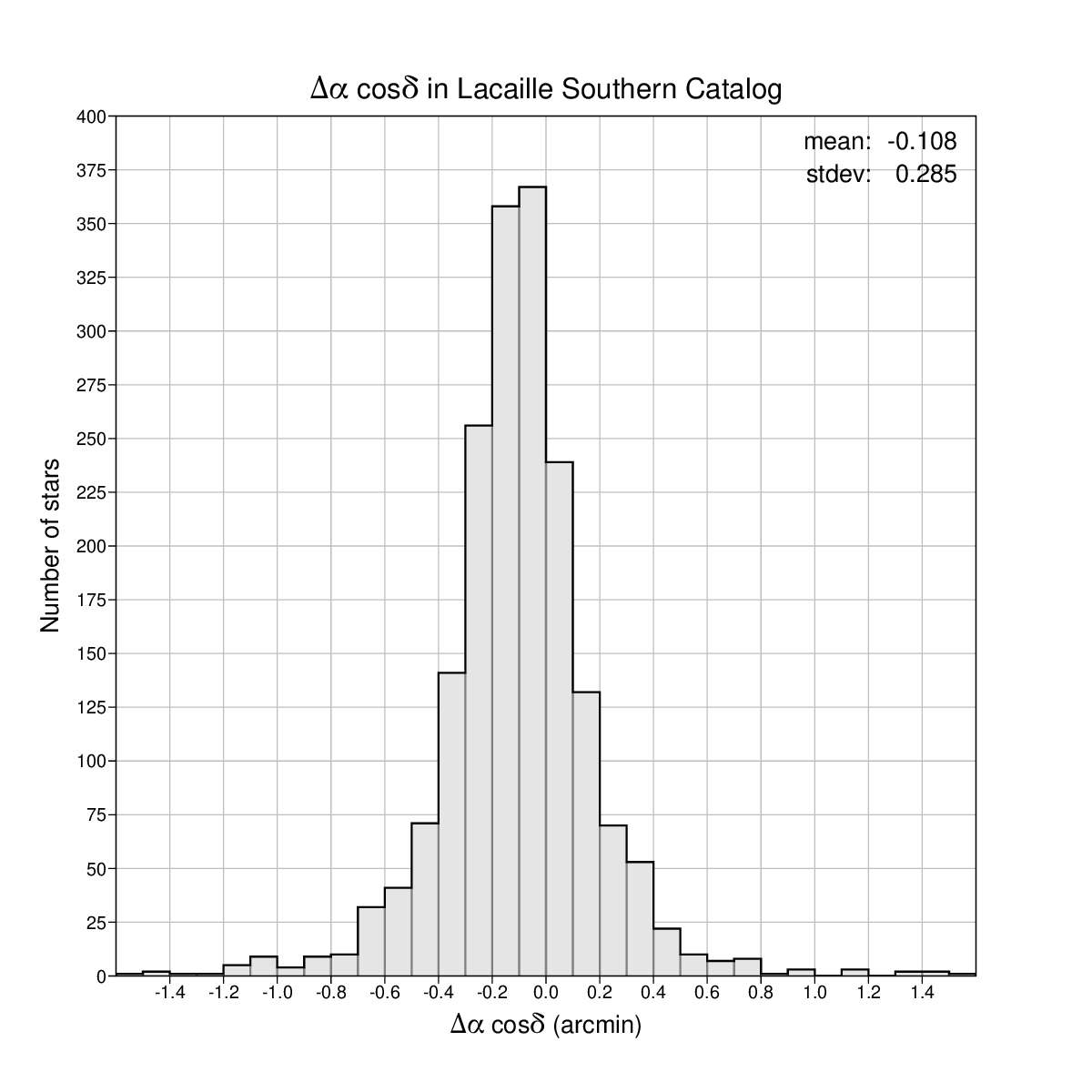
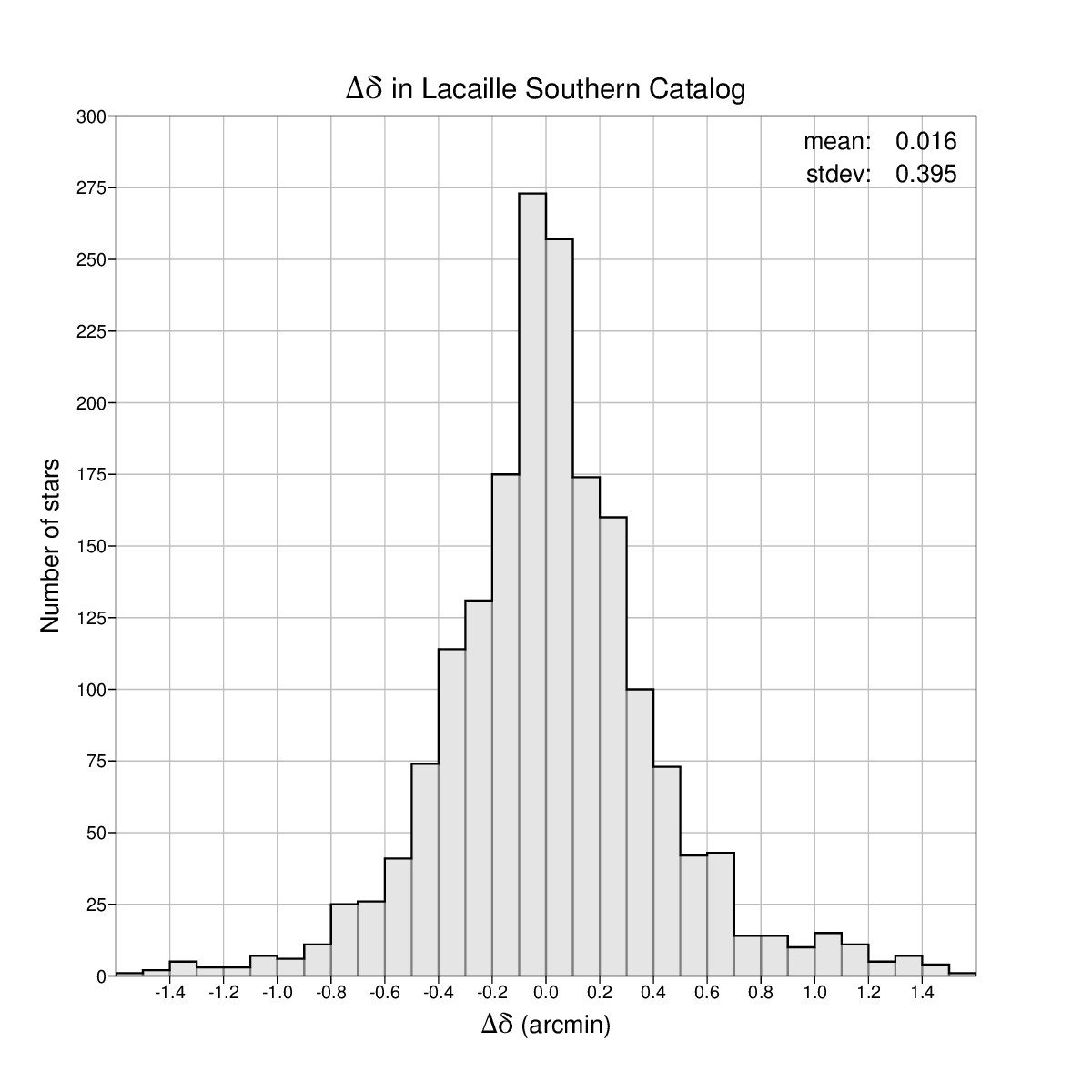
The file dists.dat mentioned above gives the differences in right ascension (multiplied by the cosine of the declination for normalization), the differences in declination, and the great circle distances, all in minutes of arc, between Lacaille's positions and modern ones (from the Hipparcos or SAO catalogs) adjusted to the 1750 equinox for proper motion and precession.
The corresponding histograms below give an idea of the overall accuracy of the catalog (data outside the range of the x axis has been discarded).
| Right Ascension | Declination | Distance |
|---|---|---|
 |
 |
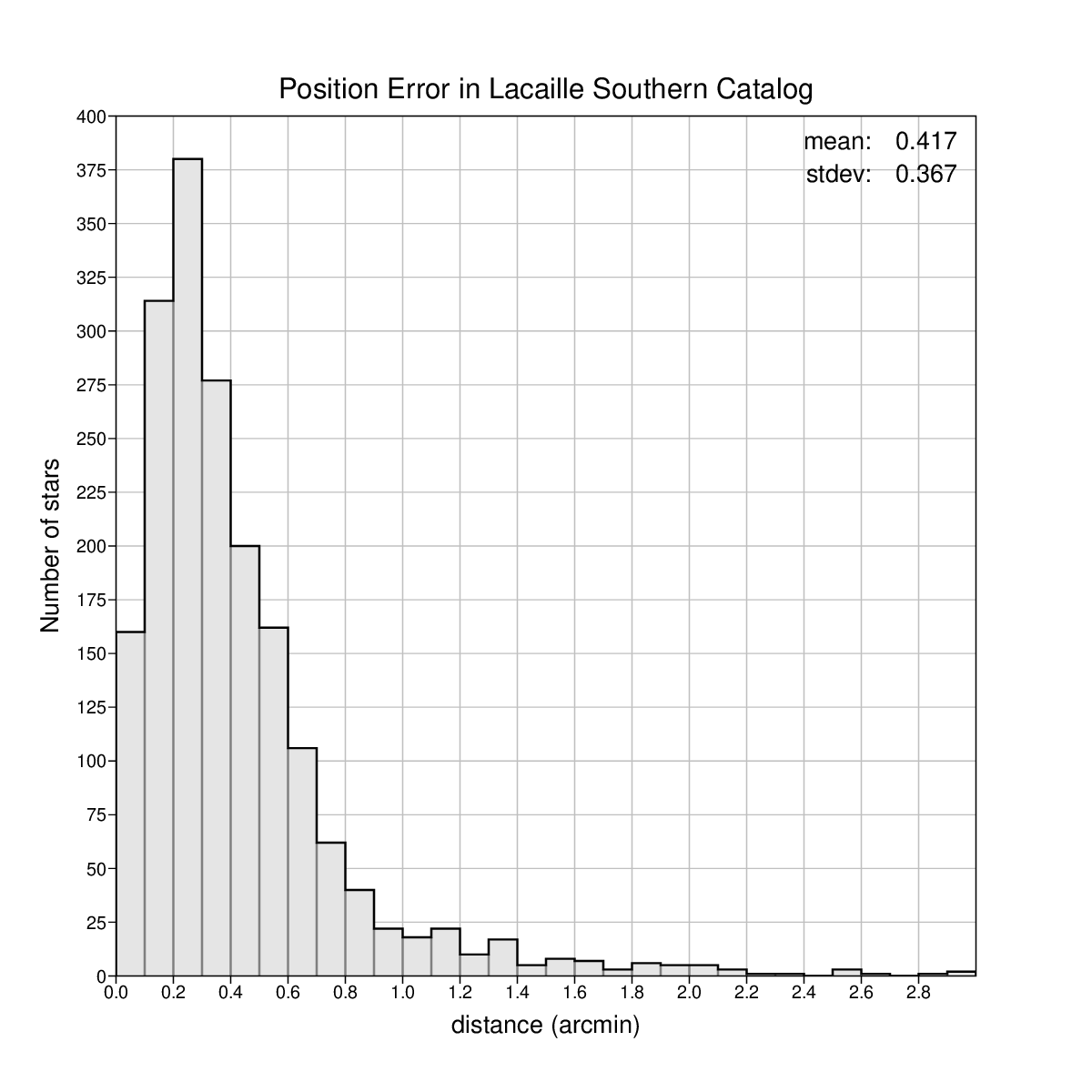 |
The peak of the distance histogram occurs at about 0.3 arcmin, vs. 0.6 arcmin for Flamsteed's catalog, and 2 arcmin for Tycho's. Using this value as a measure of accuracy, we could say that Lacaille's catalog is twice as accurate as Flamsteed's.
References
[1] Morton Wagman, Lost Stars, McDonald & Woodward Publishing Company, Blacksburg, Virginia, 2003.
[2] Benjamin Apthorp Gould, Uranometria Argentina, Buenos Aires, 1879.